

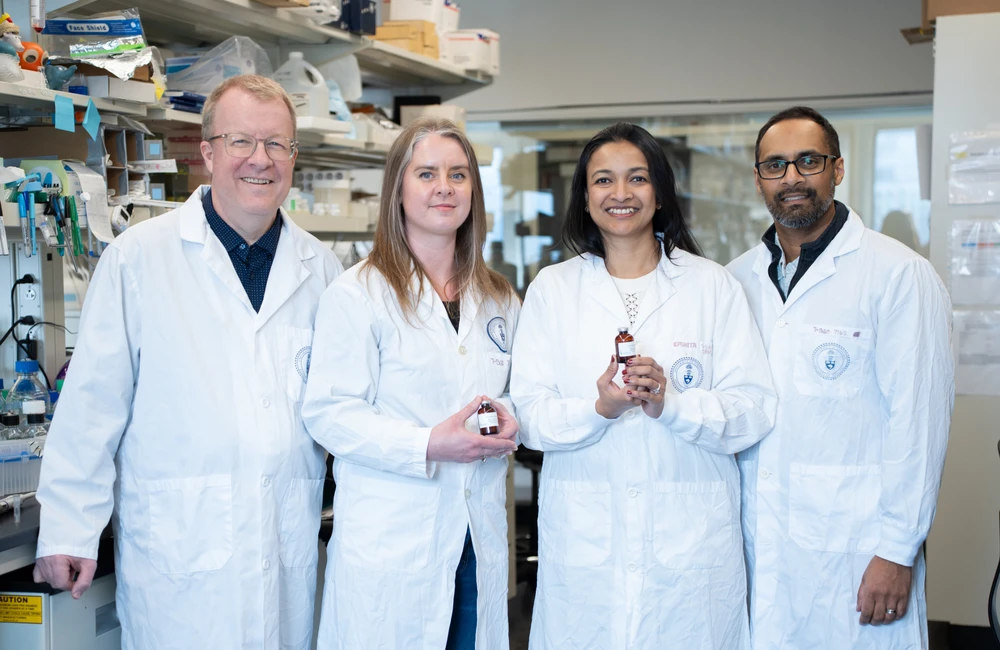
From left: Scott Gray-Owen, Jamie Fegan, Epshita Islam and Trevor Moraes (Photo: Rulin Yuan)
14 April 2026
By Betty Zou
A vaccine developed by Emerging & Pandemic Infections Consortium (EPIC) researchers at University of Toronto is one step closer to market with the signing of a commercialization agreement between U of T, the Global Alliance for Livestock Veterinary Medicines (GALVmed) and animal health vaccine manufacturer BioVet.
The partnership will advance a next-generation cattle vaccine against hemorrhagic septicemia — a deadly disease caused by the bacteria Pasteurella multocida — for use in sub-Saharan Africa and South Asia.
The fundamental research that led to this milestone began over a decade ago at U of T’s Temerty Faculty of Medicine and was co-led by biochemistry professor Trevor Moraes, molecular genetics professor and EPIC’s academic director, Scott Gray-Owen, along with University of Calgary professor Anthony Schryvers.
The journey began in 2016 when Yogesh Hooda, a PhD student in Moraes’ lab, discovered a new protein on the surface of P. multocida. The discovery came at an opportune time.
Canada’s International Development Research Centre, in partnership with the Gates Foundation, was about to launch the Livestock Vaccine Innovation Fund, an initiative to accelerate the development and production of vaccines to improve the health of livestock and protect the livelihoods of farmers in low- and middle-income countries. One specific focus of the funding competition was hemorrhagic septicemia (HS).
Hemorrhagic septicemia primarily affects cattle and buffalo and is marked by rapid progression and high mortality. Across regions of Africa and South Asia, the disease can have devastating economic and cultural impacts on livestock-keeping communities, particularly smallholder farmers who rely on a few animals to sustain their livelihoods.
The current vaccine for hemorrhagic septicemia relies on heat-killed bacteria and, as Moraes notes, does not offer effective long-lasting or broad protection against the multiple strains of P. multocida that cause HS.
“Our job was to try to identify proteins that we could use as a subunit-based vaccine,” says Moraes.
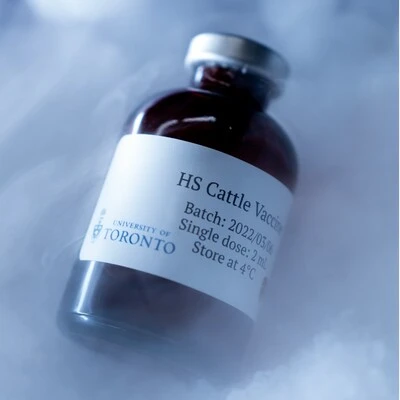
He says that because the newly discovered protein, called PmSLP, is nearly identical across different HS-causing bacteria strains, they hypothesized that it could lead to robust protection against the disease.
To test their idea, Epshita Islam and Jamie Fegan, research associates in the Moraes and Gray-Owen labs respectively, teamed up to develop a mouse model of P. multocida infection and showed that a PmSLP-containing vaccine was fully protective.
“We didn’t expect it to be so potent in mice,” says Moraes. “The next stage was to test the vaccine in large animal challenge experiments.”
Working with researchers at the National Veterinary Institute in Ethiopia, they immunized cattle with the PmSLP vaccine and found that vaccinated cattle had survival rates of 75 to 87.5 per cent when exposed to high doses of bacteria in pilot studies, compared to zero per cent among the cattle that received a placebo vaccine.
After establishing the effectiveness of PmSLP as a vaccine candidate, the researchers set out to optimize their vaccine for real-world conditions. They consulted with local veterinarians in Bhutan and Ethiopia to understand what it would take to make their vaccine accessible to the communities who most needed it.
“Right from the beginning, we knew that for the vaccine to be viable, it had to be low cost and ideally one dose. It had to be able to be mass produced with ideal stability criteria,” says Islam.
To address some of those concerns, the researchers tested different adjuvants to determine which ingredient could help the vaccine generate the strongest and longest-lasting immune response. They identified one adjuvant that led to 100% protection after a single dose as early as 5 weeks post-immunization, leading to durable antibody levels and protection.
The researchers also showed that the PmSLP protein component of the vaccine could be freeze-dried and stored at room temperature or in a fridge for one year without impacting its stability or its ability to generate a highly protective immune response.
Fegan says that the remarkable stability of the PmSLP protein was critical in overcoming some of the logistical hurdles associated with delivering the vaccine to the low- and middle-income regions most affected by the disease.
For example, she and Islam shipped the made-in-Toronto vaccines to Ethiopia for the cattle studies, but shipments would sometimes get stuck in customs at unpredictable temperatures for two weeks or longer. Despite these challenges, the vaccines retained their effectiveness at protecting against hemorrhagic septicemia.
“It’s one thing to see protection in a lab-based setting where you can control all of these variables, but it was really cool to see what actually happened under more real-world conditions,” says Fegan.
To bring their vaccine to market, Moraes, Gray-Owen and Schryvers created a spinoff company called Engineered Antigens Inc through which they’ve given production and usage rights for the PmSLP vaccine to all low- and middle-income countries. Under the new partnership with GALVmed and BioVet, BioVet will manufacture the vaccine at scale, conduct safety and efficacy testing, including in the field, and secure market authorization.
Back in the lab, Moraes and Gray-Owen are building off the success of their PmSLP vaccine to develop a vaccine against bovine respiratory disease, which is also associated with P. multocida infection and common in beef cattle feedlots across North America and Europe.
“It’s really satisfying to see something move from discovery of a protein to real-world application and utility,” says Moraes.
“It doesn’t happen every day.”