

Welcome to the Emerging Pathogens & Infectious Diseases Consortium
Welcome to EPIC – the Emerging Pathogens and Infectious Diseases Consortium.
EPIC brings together researchers, clinicians, and institutions across the University of Toronto and its hospital partners to advance infectious disease research and build lasting resilience against emerging threats.
This work builds on a long legacy: EPIC partners have played an integral role in infectious disease research for a century, from work that helped control diphtheria and eradicate smallpox, to today’s front-line research in antimicrobial resistance and infection control. Our collective response to COVID-19, highly pathogenic avian influenza, and mpox makes clear there’s never been a more important time to advance that work, from emerging pathogens and antimicrobial resistance to health inequities and public trust.
Building on this momentum, EPIC marshals the advanced research infrastructure and world-renowned research and training expertise of our EPIC partners to deliver an integrated, innovative response to the infectious disease challenges facing communities today and in the future.
Seven EPIC research clusters

Antimicrobial resistance
Protecting the effectiveness of the medicines we depend on.

Chronic infections and long-term sequelae
Addressing the long-term burden of infections that don’t resolve.

Emerging and re-emerging pathogens
Detecting and responding to new and re-emerging threats before they spread.

Health inequities
Ensuring infectious disease research and response reach everyone, equitably.

Health systems resilience
Building health systems that bend, not break, under infectious threats.

Misinformation, disinformation and public trust
Strengthening public trust through clear, credible information.

Sepsis and acute infections
Improving detection and treatment when every minute counts.
EPIC News
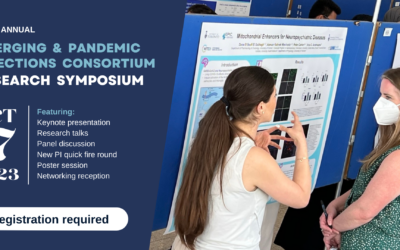
October 17, 2023: First annual EPIC Symposium
We are excited to announce that the first annual Emerging and Pandemic Infections Consortium symposium will take place on October 17, 2023 at the Old Mill Toronto Hotel! Please join us for a day of research, networking and community-building.

This AI will help us get ahead of the next pandemic
It seems appropriate that the Toronto offices for Kamran Khan’s BlueDot, which uses artificial intelligence to flag potential infectious disease outbreaks around the world, are located at the edge of Lake Ontario. Similar to a lighthouse, BlueDot signals when there’s danger ahead. BlueDot’s intelligence platform combines a computer’s ability to understand human language, known as natural language understanding (NLU), and machine learning, a form of AI that imitates humans’ ability to learn and gradually become more accurate. The platform sorts through massive volumes of online information— ranging from news reports, social media sites, government websites, and more — from around the globe, in over 130 languages, every 15 minutes of every day.

MD/PhD student Hannah Kozlowski receives inaugural Future Leaders Prize
Hannah Kozlowski is the inaugural recipient of the Future Leaders Prize from the Emerging and Pandemic Infections Consortium. The prize, to be awarded annually, recognizes outstanding PhD graduates at the University of Toronto who have completed an excellent infectious disease-focused thesis and demonstrated leadership outside of their scientific studies.


