

Welcome to the Emerging Pathogens & Infectious Diseases Consortium
Welcome to EPIC – the Emerging Pathogens and Infectious Diseases Consortium.
EPIC brings together researchers, clinicians, and institutions across the University of Toronto and its hospital partners to advance infectious disease research and build lasting resilience against emerging threats.
This work builds on a long legacy: EPIC partners have played an integral role in infectious disease research for a century, from work that helped control diphtheria and eradicate smallpox, to today’s front-line research in antimicrobial resistance and infection control. Our collective response to COVID-19, highly pathogenic avian influenza, and mpox makes clear there’s never been a more important time to advance that work, from emerging pathogens and antimicrobial resistance to health inequities and public trust.
Building on this momentum, EPIC marshals the advanced research infrastructure and world-renowned research and training expertise of our EPIC partners to deliver an integrated, innovative response to the infectious disease challenges facing communities today and in the future.
Seven EPIC research clusters

Antimicrobial resistance
Protecting the effectiveness of the medicines we depend on.

Chronic infections and long-term sequelae
Addressing the long-term burden of infections that don’t resolve.

Emerging and re-emerging pathogens
Detecting and responding to new and re-emerging threats before they spread.

Health inequities
Ensuring infectious disease research and response reach everyone, equitably.

Health systems resilience
Building health systems that bend, not break, under infectious threats.

Misinformation, disinformation and public trust
Strengthening public trust through clear, credible information.

Sepsis and acute infections
Improving detection and treatment when every minute counts.
EPIC News
U of T partners with Moderna to advance research in RNA science and technology
By Rahul Kalvapalle The University of Toronto and Moderna, Inc. – known for its mRNA-based COVID-19 vaccine – plan to work together to develop new tools to prevent and treat infectious diseases. Guided by a partnership framework agreement, the U.S. biotechnology firm...
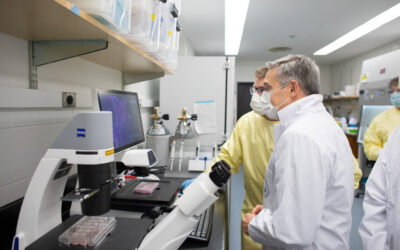
In the next pandemic, Canada will be prepared
The Toronto High Containment Facility (THCF), housed at the University of Toronto’s Temerty Faculty of Medicine, is equipped to safely study pathogens that cause infectious disease, and was among the first labs in Canada to enable researchers to work with SaRS-CoV-2 samples.
While similar facilities elsewhere had closed after the 2003 SARS outbreak, the U of T lab remained open – supporting a vast research community including academic, hospital and industrial research needs – and was able to make a significant contribution to understanding and addressing the COVID-19 pandemic.
Canada Foundation for Innovation support advances collaboration among U of T, SickKids and UHN researchers
Originally published on the University of Toronto Rahul Kalvapalle Two projects involving researchers at the University of Toronto and its partner hospitals, each aimed at better understanding and tackling COVID-19, have been awarded a combined total of nearly $2.5...


